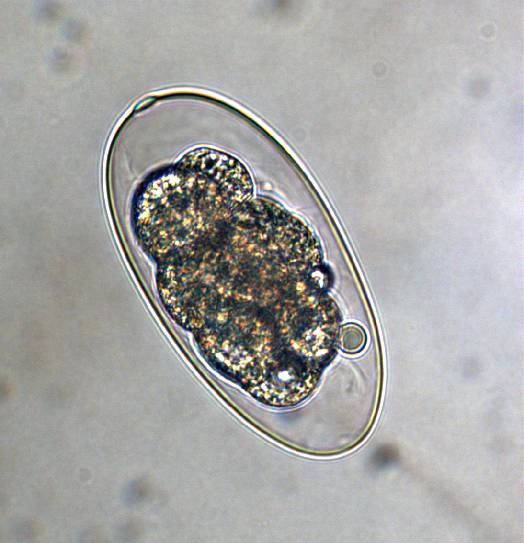
Eggs of large strongyles are
generally smaller than those of
small strongyles, but the different
groups are not distinguishable
without detailed measurements.
The same applies for
Trichostrongylus axei. Faecal
sample must be cultured to obtain
third-stage larvae (L3) for further
differentiation.
Longitudinal oval, thin-shelled eggs with smooth
surface and evenly rounded poles (strongyle type).
Dark, spherical blastomeres fill eggs only partially.
70-110 x 30-54 µm in size.