ANSC20003 Topics in Animal Health
Prac 3: Virus Spread Simulation
Prac 3: Virus Spread Simulation


Introduction
When serious emergency (exotic, highly infectious or very pathogenic) diseases occur the effectiveness of the response is generally dependent on the efficiency and promptness of the action taken. This requires planning and training. This is preferably not only reliant on experience with previous outbreaks! An important method for developing the capacity to respond to these outbreaks is through simulation. Simulations of infectious disease outbreaks are becoming an increasingly important exercise in predicting the outcomes and effects. Simulations can be of two forms.Computer-based models are developed to replicate the behaviours of an outbreak. The more sophisticated the model the more useful it is to analyse the likely scenarios that may arise. Models of viral infections such as Foot and Mouth Disease have been developed. These have been used to analyse the results of control strategies. A recent model based on the data from the 2001 outbreak in Europe predicts that the use of vaccination would in fact slow down the control effort for this case. The relative effectiveness of “shutdown” (no movement of animals) versus vaccination was modeled on the data from the 2007 Equine Influenza outbreak in Australia.
To gauge the preparedness of a system to respond to an outbreak, exercises have been run to test the effectiveness of control processes and highlight weaknesses in control strategies. In 2003 the Department of Primary Industry ran an extensive simulation of a Foot and Mouth outbreak across Australia called ‘MINATOR’. The key personnel involved in control and representatives from within the rural industries and organisations responded to the developing scenario. Analysis of the responses enabled better response procedures to be developed.
Several subsequent simulation exercises have been run for other diseases and components of the response plans, including:
- Pegasus 2005(tested response to African Horse Sickness)
- Exercise Hippolytus 2007 (tested animal disease diagnostics)
- Exercise Cowcatcher 2004, 2007 (tested the National Livestock Identification System)
- Exercise Eleusis 2005 (tested response to bird flu outbreak)
- Exercise Tethys 2003 (tested response to an aquatic disease outbreak)
- Exercise Wild Boar 2008 (simulated a response to an outbreak of classical swine fever in the Northern Territory)
- Exercise Diva 2009 (to test Victoria’s capability to deal with a hypothetical outbreak of foot and mouth disease)
- Exercise Red Feather 2012 (designed to review, develop and refine Queensland’s existing policy frameworks and preparedness for an outbreak of highly pathogenic avian influenza)
- Exercise Phantom Fox 2012 (simulated a response to clinical bluetongue disease in sheep in South Australia, and practised, among other things, the RRT’s integration into a simulated emergency animal disease response in South Australia)
- Exercise Control Freak 2013 (a professional development activity aimed at enhancing the RRT members’ knowledge and application of contemporary control/coordination centre functions based on a foot-and-mouth disease scenario)
- Exercise Slapstick 2015 (practicing the application of FMD vaccination strategy, policy and procedures for a specific scenario in south east Queensland)
- Exercise Apollo 2016 (to assess the preparedness of the Department of Agriculture and Food Western Australia’s preparedness to a major biosecurity incident)
- Exercise Athena 2016 (an international functional exercise held to test the International Animal Health Emergency Reserve (IAHER) agreement).
The exercise we are conducting today will be using a simple model of viral spread to develop basic strategies of control. It represents an outbreak into a previously unexposed population of a virus that has a very high rate of infectivity, low numbers of contacts and persistent periods of virus shedding and can be diagnosed with a highly sensitive and specific test. As with most real-life situations there will be insufficient tests or time available to test all possible cases at one time.
This simple model will approximate the spread of a number of viral diseases including:
• Foot and Mouth from farm to farm
• Avian Influenza from region to region
• Equine Influenza from animal to animal
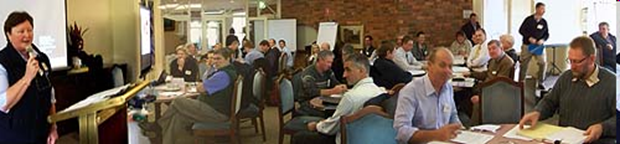
Training sessions during simulation exercises