
ANSC20003 Topics in Animal Health
Prac 4: Parasitology
Prac 4: Parasitology


Introduction

Weaner sheep
Parasites are a major threat to the health of our domesticated animals.
We will initially focus on the issue of sheep parasites in Southern Victoria.
Internal parasites or ‘worms’, are one of the major causes of production inefficiency in Victorian sheep flocks. One of foremost concerns is the economic loss associated with the decline in lamb growth rates as a consequence of worms. Victoria Farmers Federation Factsheet
The internal parasites affect especially young sheep causing:
- Scouring
- Weight loss
- Anaemia
- Lethargy
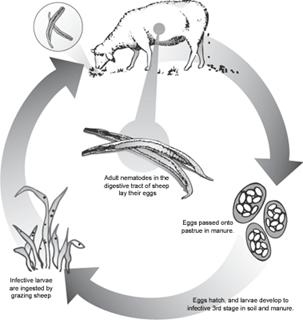
Strongyle worm cycle
Prevention of prasite burdens needs to be based on an understanding of the parasite/ host / environmental cycle.
The main worms in sheep result from eating pasture that contains worm larvae. Worm larvae develop from the eggs shed from the intestinal worms The main risk is the number of eggs being deposited on pasture. This can very extensive e.g. if a sheep has a worm burden of 5,000; Egg output: 4,000/worm/day = 20 million per sheep per day!
The key to prevention is to prevent eggs getting on to pasture. The main technique to monitor pasture contamionation is the Faecal Egg Count (FEC). This is tyhe technique we will be focusing on in this Prac.
Collecting the faeces
The easiest way to collect samples is:- Move sheep into a corner or alongside a fence with minimal faeces
- Quietly stand them for 5 minutes
- Slowly move them away
- Collect several samples of about 50g (a few pellets)
- Sore in a refrigerator
- Test within 24 hours (before the eggs hatch)