ANSC20003 Topics in Animal Health
Prac : Parasitology
Prac : Parasitology


Methods
The technique we are using here is only one of many. This technique aloows us to undertake a number of tests quickly and accurately. Other techniques do not require laboratory setups and equipment e.g. a centrifuge, and can be undertaken on the farm by trained farm staff.Perform the Faecal Egg Counts (FECs) each for each scenario (Samples 1 to 4).
- Prepare the counting slide by cleaning the inside of the slide with cold tap water and a folded filter paper thoroughly. After cleaning, rinse with cold water, then shake off excess water and dry the outer surfaces with a Kimwipe tissue.
- Weigh 10g of fresh faeces into a small beaker.
- Add 40ml of tap water to the faeces in the beaker using the measuring cylinder.
-
Thoroughly break up and mix faeces with a plastic fork until no clumps of faecal material remain.
NB: Failure to mix the sample thoroughly will result in an inaccurate egg count.
- Place the strainer over a clean beaker. Gently swirling the contents in the beaker containing faeces and tap water pour the mixture into the strainer to separate the liquid (containing eggs) and faecal matter. If required, gently shake the strainer to help the liquid pass through. Discard the strained material.
-
Swirl to mix the liquid then pour immediately into a 50ml centrifuge tube, identified with your pair, scenario and sample numbers.
Faecal sample preparation
-
Fill the test tube with the thoroughly mixed contents of the beaker, then centrifuge at 2000 rev/min for 2 minutes to produce a plug of debris containing the eggs.
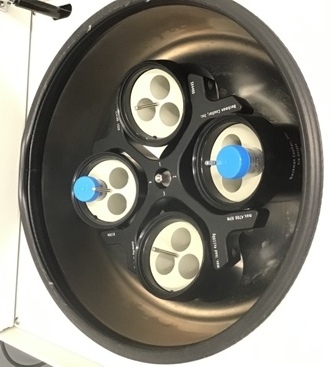 Filling the centrifuge with 50 mL Centrifuge Tubes
NB: An alternative method is to place the test tube in a refrigerator for 1 hour. This allows time for the eggs to settle at the bottom of the test tube in a cold environment which delays development of the eggs. - Taking care not to disturb the pellet at the bottom of the test tube, pipette off the supernatant (the liquid). If the contents become accidentally mixed, centrifuge the sample again.
-
Add 42ml of saturated salt solution (SSS).
Diluting faeces in supersaturated salt solution -
Cap the tube and invert 15 - 20 times to thoroughly mix the contents and resuspend the pellet and distribute the eggs evenly through the solution. If the pellet doesn’t dislodge, flick the end of the pipette with your finger until it does.
NB: Be sure the pellet is resuspended before proceeding. Failure to do so will result in an inaccurate egg count. Once mixed, take a sample of the solution and immediately fill two chambers of the counting slide, taking care to avoid the formation of air bubbles. Some will inevitably form but too many will make analysis difficult.
Filling the counting chambers - Wait at least 3 minutes for all eggs to come to the surface but do not commence counting until at least this time period has elapsed since eggs may not have had sufficient time to float.
- During this time, focus in the first chamber on the small air bubbles at the top of the liquid surface as this is where the eggs will also be floating.
- Count the number of eggs in each counting strip (in the two chambers) and record your results in either Table 1 on your group’s data recording sheet, as appropriate.
- Calculate the number of eggs per gram (epg) of faeces.
Calculation
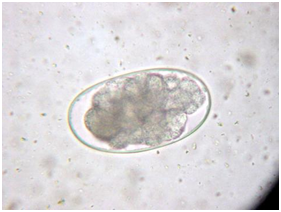
A strongyle egg
To determine the number of eggs per gram (epg) of faeces using the Whitlock Universal slide, the dilution factor and measurement volume used must be considered.
Dilution factor = 10g faeces (3 ml) in 45ml solution = 1 in 15 dilution
Measurement volume = 5 x 0.1 ml strips x 2 chambers counted = 1 ml
FEC epg = raw egg count x dilution factor x measurement volume factor
= raw egg count x 15 x 1
= raw egg count x 15